Total Pageviews

Saturday, 22 February 2020

Black Tower British Gold Collection 2


A4
Paperback
B&W
Price: £8.00 (excl. VAT)Prints in 3-5 business days

The second collection of British 1940s comic strips featuring Maxwell The Mighty, Slicksure, Iron Boy,Alfie, Ace Hart and more.

Featuring the work of Golden Age Greats Alf Farningham and Harry Banger.
Specifically designed to feature more humour than the previous volume this should be a treat for all comic collectors. Reprinting the full content of The Meteor and The Rocket Comics from 1948.

Black Tower British Gold Collection 1


A4
B&W
94 pages
Price: £8.00 (excl. VAT)Prints in 3-5 business days

For the first time in 60 years some of the lost gems of the British Golden Age of Comics are reprinted!
Scanned and cleaned to the best standard possible -see The Phantom Raider, Ace Hart, Secrets Of The Super Sargasso Sea, Phantom Maid, Electrogirl, Skybolt Kid, Wonder Boy, Dene Vernon, Professor Atom and many, many others!
Its fun and action all the way -The British Golden Age shines through!

Wednesday, 20 November 2019

British Golden Age Comics

Is on Face Book pending deletion of all Yahoo  groups and indications that Blogger may be about to make changes

https://www.facebook.com/groups/531190066953781/

Monday, 21 October 2019

Samuel Assael aka John Spencer


"John Spencer" was the pseudonym of Samuel Assael (born 1920), who set up his London-based publishing company in 1947.

Initially Spencer's output consisted of pulp magazines, mainly in the science fiction genre (with titles like Futuristic Science Stories, Tales of Tomorrow *and Wonders of the Spaceways). However, with the decline of the pulp magazine and rise of the paperback, Spencer switched to paperback publishing in the mid-1950s. He used a number of imprints, including "John Spencer", "Cobra" and "Badger", but the last of these has become the best known. The Badger Books imprint was discontinued in 1967 although Spencer continued to produce a small number of books (often reprints) until the late 1970s.


In common with other "pulp" or mass-market publishers of the time, Badger Books focused on quantity rather than quality. A new title in each of the major genres appeared each month, generally written to tight deadlines by low-paid authors. One of the most remarkable facts about Badger Books is that much of its outputs was produced by just two authors (using a range of house names and other pseudonyms): John Glasby (over 300 novels and short stories) and Lionel Fanthorpe (over 200 novels and stories).


The bulk of Badger Books' output fell into five genres as follows:


Westerns, published as "Lariat Westerns" (LW-1 to LW-77) and "Blazing Westerns" (BW-1 to B-60). Many of these novels appeared under the house name "Chuck Adams", which was used by John Glasby and others. At least two of the Chuck Adams books, and several of the other western titles, were written by E. C. Tubb, who later became better known as a science fiction author.


War stories (WW-1 to WW-163). Generally set during the Second World War, most of these novels were written by John Glasby using a wide range of pseudonyms.
Romance novels (RS-1 to RS-40). The bulk of these were written by John Glasby under the pseudonym of D. K. Jennings.

Supernatural tales (SN-1 to SN-109). Most of these books were written by Lionel Fanthorpe under a variety of pseudonyms. Unlike the other series (which are all novels), the SN books started out as anthologies of short stories. Novels started to appear as "Supernatural Specials" with issues 29, 32 and 35, and then all the even-numbered issues from SN-40 onwards.

Science Fiction (SF-1 to SF-118). Like the SN series, the SF books were mainly written by Lionel Fanthorpe, with a few contributions by John Glasby and others. Several of these books appeared under the house name of "John E. Muller", which was used by both Fanthorpe and Glasby.

In addition to these five main genres, there were several other short-lived series such as Crime stories (CS-1 to CS-13) and Spy stories (SP-1 to SP-6). The latter books, dating from 1965 to 1967, were intended to "cash-in" on the then-current James Bond craze. All six of the Spy books were written by John Glasby under the pseudonym of Manning K. Robertson.


 References

Debbie Cross, Down the Badger Hole: R. Lionel Fanthorpe: the Badger years. Wrigley Cross, Portland 1995.

Terry Hooper,The Secret Worlds Of  Samuel Assael,Comic Bits no.7,2004,including notes from an interview.

Sunday, 20 October 2019

John Armstrong 1923-2018

John Armstrong in 2003 photo (c) Jenni Scott

From Wikipedia, the free encyclopedia


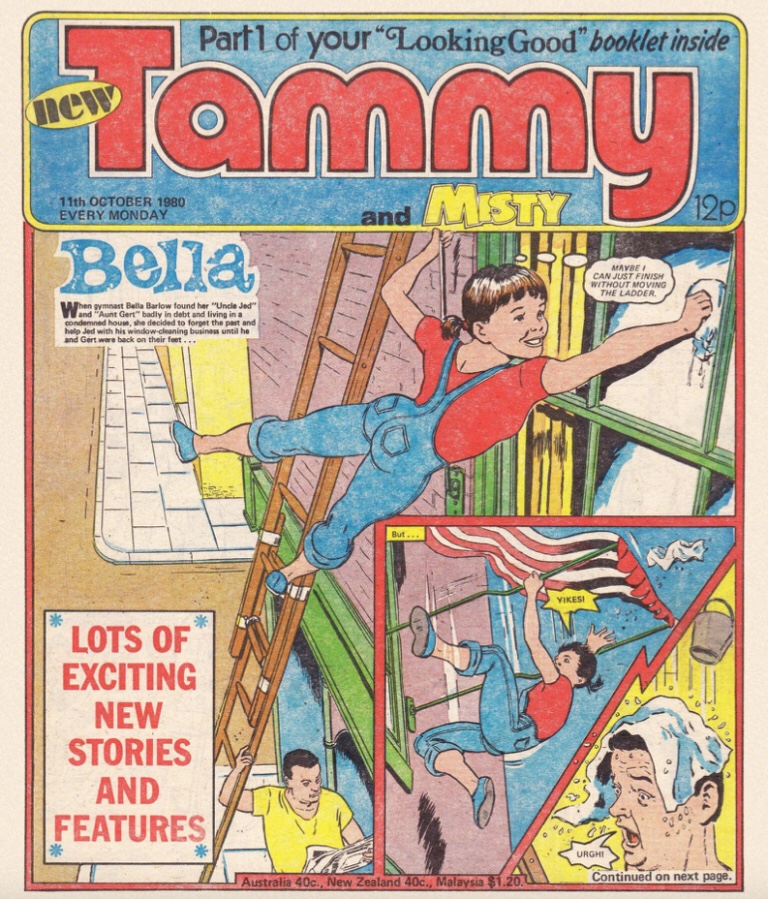
John Armstrong is a British comics artist, best-known for his work in Misty and Tammy, for which he drew the long-running strip Bella. Other strips he has drawn include The Secret Gymnast in Bunty.


Although one of the few acknowledged artistic pupils at his infant, junior and secondary schools, John Armstrong's first proper art lessons were whilst serving in the Army, in the Far East. "To keep us occupied, art lessons were started in a deserted palace outside Rangoon; local people in ethnic dress posed for us," he recalled in 2003. "I still have portraits of Burmese and Indian women, and West African and Indian soldiers.

On leaving the army, this course and its artwork steered John to art school in Middlesbrough’s Constantine College. In five years he passed Intermediate Arts and Crafts and gained National Diplomas in Design in both painting and illustration – making me more qualified than any of the staff.

On the Principal’s advice he next did a year in Teacher Training College. The students used to take the bus to various schools for teaching practice. "Two characters who sold toy bows and arrows in the local market boarded the same bus and expressed their amazement that an aspiring teacher was always reading a comic," John recalls. "In those days “educationists” regarded comics as a subversive element.

"On teaching practice I’d amuse the kids by drawing Tarzan a la Hogarth on the blackboard. The kids got to like me and would beg, “Don’t be a teacher, sir!” With this excellent advice and with my art school specimens I got my first job in a Newcastle Ad Agency, meeting with commercial artists for the first time – a daunting experience. I was astonished by the skill of the head layout artist who would simulate a brochure – photos, lettering, typesetting – all by hand using pencils, inks and water colour so that it looked exactly like the eventual printed article. Art schools knew nothing about such expertise."

After a year there John headed south and pounded the streets of London with a heavy folder filled with art school work. Using an A-Z and a Writers and Artists Year Book he visited about 40 studios, publishers and agents and eventually got a job in a studio opposite St. Paul’s Cathedral and soon got his first freelance commission from Putnams Education Department for a poetry book. Quite a lot of school book work followed.

Armstrong acquired an agent in London's Holborn one year later and soon got his first comics job, a ballet story for Girl's Crystal. It was girls comics from then on.

John regards his most notable stories as the strips he drew for IPC: Cherry and the Children, which ran for five years, and Bella, which covered 10 years in Tammy. Bella was, it appears, the only character to get her own book at IPC.

John later worked on the girls title Misty, work he saw as a relief from trying to draw thousands of gymnastic poses without repeating himself. Misty was a success despite – or because of – its horror story content aimed at young girls.

After the demise of Tammy and Misty, John drew the comics version of the popular children’s school drama Grange Hill for a new magazine, BEEB for about a year. he then began working for DC Thomson, doing colour work for the first time on several annuals and for Bunty covers – plus some horse stories, his original passion.

In recent years John has provided artwork for ice rink pantomimes while gradually reviving his oil painting skills, mainly doing portraits of skating friends.

(Details taken from biography supplied for the Raptus 2003 convention in Norway.)